
The NHL goalie mask didn’t start as a piece of art. It started as survival gear. First worn to stop a puck from destroying someone’s face, it has grown into something bigger and something cultural. Today, it is not just about safety. It is a billboard, a canvas, and a statement of identity.
This transformation didn’t happen overnight. It took decades of pain, creativity, and a few brave goalies refusing to play without one. Now, it is hard to imagine hockey without the bold designs and fierce energy of a painted mask. The NHL even honors them during Goalie Week every September, and there is a good reason why.
Where the Goalie Mask Story Begins
The NHL goalie mask owes its roots to a simple idea: save the face. Back in 1927, Elizabeth Graham wore a fencing mask to protect her teeth. Then, Clint Benedict tried a leather version in 1930, but ditched it because he couldn’t see well.
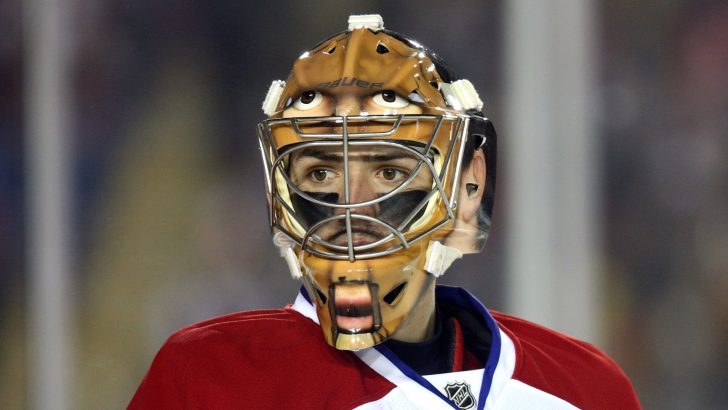
NHL / IG / Everything changed in 1959. Jacques Plante of the Montreal Canadiens took a puck to the face. Needed stitches. Refused to return unless he wore a mask.
His coach didn’t like it, but Plante won the argument. And the game. That was the moment masks became real.
Plante’s fiberglass mask was basic. It fit his face but didn’t breathe well or offer much vision. It worked, though, and other goalies started to follow. Soon, small design tweaks, like padding and ridges, made them stronger and more comfortable.
By the early ‘70s, everyone in the NHL was masked up. The last guy to play without one was Andy Brown in 1974. Once goalies stopped worrying about their faces, they started playing lower and faster. It totally changed how the position worked.
Turning Injuries into Identity
Gerry Cheevers of the Boston Bruins kicked off the art revolution. He just took a puck to the mask during practice. His trainer drew stitches where the puck hit. Cheevers liked it. Kept adding more.
Those “stitches” told a story. They showed the hits that didn’t hurt because the mask did its job. Fans loved it. Suddenly, masks weren’t just gear. They were stories. Personal, gritty, and unique.
In 1970, Doug Favell showed up with a bright orange mask. It looked like a Halloween prop, and shooters said it was distracting.
Then came Jim Rutherford. His mask featured red wings painted over the eyes, made by artist Greg Harrison. At first, Rutherford wasn’t a fan, but that changed fast.
As masks got cooler, they also got smarter. Dave Dryden wanted something safer, so he teamed up with Harrison to make the first combo mask. It had a hard shell and a metal cage.
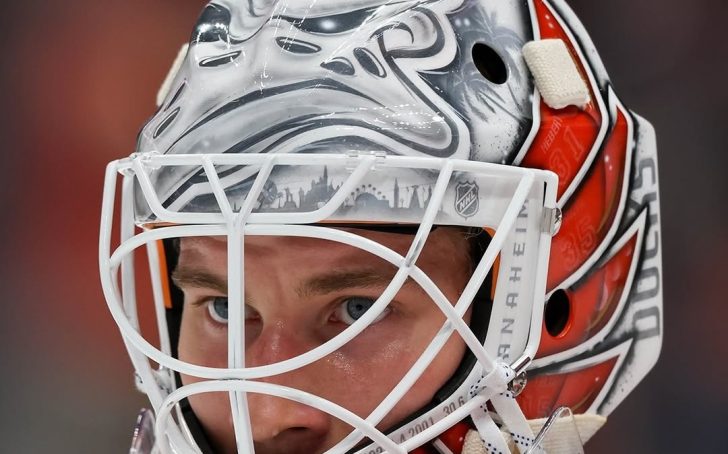
NHL / IG / Modern NHL goalie masks are high-performance machines. Built with carbon fiber, Kevlar, and special foams, they are like something out of NASA.
Artists Take Over the Crease
Greg Harrison led the charge, painting masks for most of the league. He was soon joined by others like Frank Cipra and Todd Miska.
Painting a mask was no joke. It took up to 60 hours. Strip the mask, sketch it, airbrush it, clear coat it, bake it. Costs ranged from $800 to $2,000.
Some masks defined careers. Ed Belfour’s eagle design earned him the nickname "Eddie the Eagle." Curtis Joseph’s snarling dog face became one of the most feared in the league. Felix Potvin’s cat-themed mask made him instantly recognizable. And Mike Richter’s Statue of Liberty mask screamed New York pride.
Today, they are lighter, stronger, and designed to spread out impact so goalies don’t feel the full force of a 90 mph puck.
Yet the canvas remains. The combo mask still rules. Artists now work with 3D models to ensure the design fits perfectly. And everything, from the chin to the crown, is fair game for color, texture, and story.